MCP Quality Benchmark
MCP Quality Benchmark
MCP responses were reaching 30–40k tokens per query, inflating cost, slowing generation, and degrading retrieval accuracy. I benchmarked eight MCP configurations to find the best metadata format and chunking strategy. The winner reached 92% retrieval accuracy and cut token use by 88%, and is now the MCP ingestion standard.
- Role
- Lead Designer & AI Systems Architect
- Project Type
- Design System AI Infrastructure
- Team
- Led end-to-end with 1 engineer + 1 design technologist partner
- Contribution
- Benchmarking strategy, implementation, analysis, and final recommendation
- Tools
- Cursor, Claude, MCP, React, TypeScript, Anthropic API, GitLab
- Duration
- 2 months
The Problem
The MCP had generated 4,000+ prototypes, but trivial queries grew to 30–40k tokens. That inflated cost and latency and reduced retrieval accuracy. No one knew whether the cause was the metadata format, the chunking strategy, or the infrastructure, so we could not standardize AI input or scale prototype automation reliably.
This directly caused:
- Higher token consumption
- Higher cost
- Context window pressure
- Poor signal-to-noise ratio
- Slower responses
Decision and Outcome
Which MCP configuration produces the highest quality input?
Semantic Chunker and Experiment A both performed well, but Semantic Chunker is the better value. It reached the highest retrieval accuracy (92%) and cut token use by 88% against the in-production baseline.
At 4,000 prototypes a month (about 240,000 queries a year), that saves roughly $12,000 annually and improves retrieval accuracy by 3 points. Semantic Chunking JSON is now the MCP ingestion standard.
| Rank | Configuration | Token Savings | Cost Savings | Retrieval |
|---|---|---|---|---|
| 1 | Semantic ChunkerChunking at ingestion | 88% | $0.05/query | 92% |
| 2 | In-ProductionBaseline | Baseline | Baseline | 89% |
| 3 | Experiment APre-chunked JSON | 87% | $0.05/query | 86% |
The Method
I built eight MCPs with distinct metadata pipelines, ran each on identical prompts, and isolated them on separate local ports to prevent cross-contamination. Learn more about the AIMS pipeline.
Cloned the in-production MCP repository
Generated metadata for each MCP experiment
Ingested each MCP with the new data locally
Verified all 8 MCP configurations running
8 MCP Configurations, Same Knowledge
In-Production MCP
Monolithic and verbose JSON
Semantic Chunker
Optimized MCP ingester (Infra level)
Experiment A
Pre-chunked and monolithic JSON
Experiment B
Original documentation MDX for humans
Experiment C
Only MD
Experiment D
Hybrid MD + JSON
Experiment E
Domain-separated JSON
Experiment F
TOON (Token-Oriented Object Notation)
The Framework
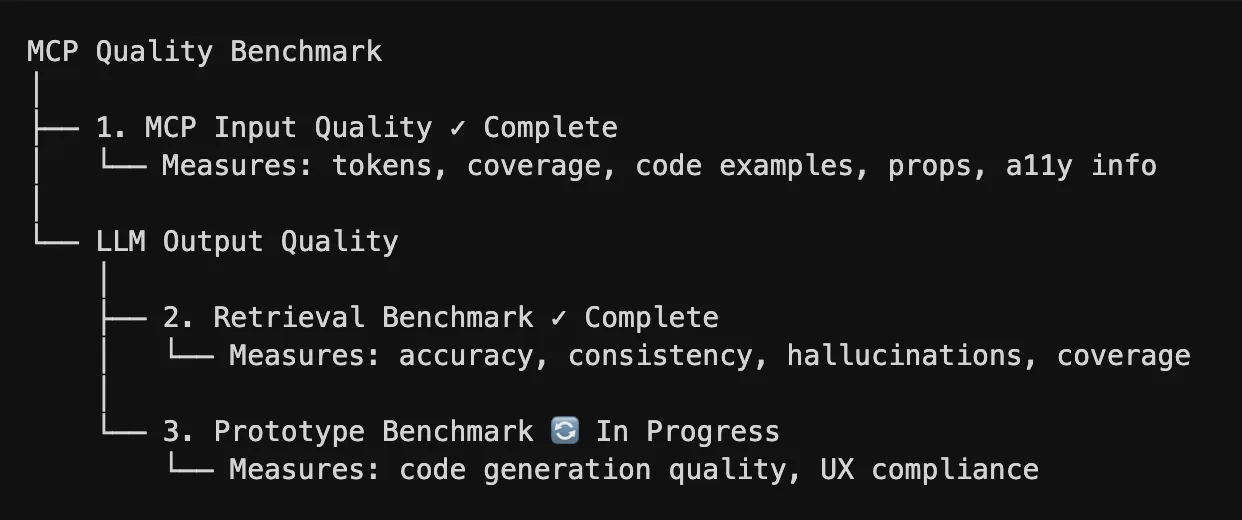
Why this matters: a benchmark means nothing without a definition of quality. I defined three dimensions, because quality is three things in balance:
- MCP Input Quality: is the MCP optimized for LLM reasoning?
- LLM Output Quality (Retrieval): can the LLM find correct information?
- LLM Output Quality (Prototype): can the LLM produce Indeed code?

Benchmark Evidence
Structured. Chunked. Smart. Coherent.
✓ Structured - JSON > Markdown
In this benchmark, JSON outperformed Markdown for LLM retrieval. Machine-parseable beats human-readable.
- Finding: Top performers (Semantic 92%, Exp A 86%) both use structured JSON formats.
✓ Chunked - Chunked > Monolithic
Breaking data into focused chunks improves retrieval. Monolithic dumps bury the signal in noise.
- Finding: Both top performers chunk their data (semantic or pre-chunked) and use deterministic JSON.
✓ Smart - Semantic > Pre-chunk
It matters how you chunk, not just whether you do. Concept-aligned boundaries preserve meaning better than arbitrary splits.
- Finding: Semantic chunking reached 92% against 86% for pre-chunked JSON: same format, different chunking strategy.
✓ Coherent - One format > Hybrid
Keep related information together, one file per component, in one consistent format. Silos fragment context. Mixed formats exhaust processing.
- Finding: Domain-separated (Exp E) reached only 20% retrieval coverage: the information was there, but siloed. The hybrid format (Exp D) hit 27% completion: the LLM could not finish.

Next Steps
This research extends beyond a single benchmark. The findings inform:
- Prototype Benchmark: Complete full quality framework evaluation before production rollout.
- Mobile Design System Documentation for MCP: Implement semantic chunking for the Mobile DS MCP.
- Design System AI Infrastructure: Work with AI leadership to integrate MCP ingestion standards into long-term AI platform strategy.
Prompt → Prototype
The prototype benchmark is the missing piece. I will complete the full framework over the coming weeks.